
Taylor Griffin · 8 September 2026
Refining Multi-Angle Attribute Networks to Streamline Query Precision in Expansive Data Repositories
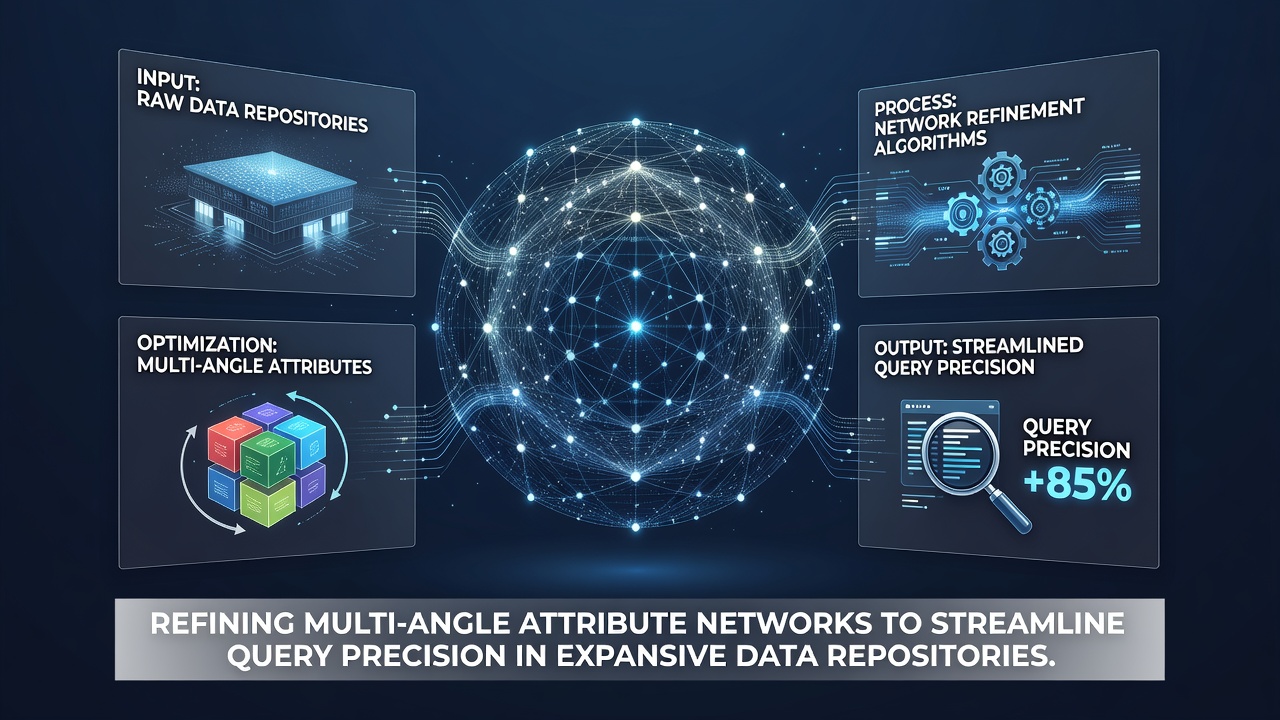
Multi-angle attribute networks represent interconnected structures that map attributes from multiple perspectives within large data collections, allowing queries to traverse relationships rather than relying on single-axis filters alone, and researchers continue to refine these systems to reduce noise while increasing result accuracy in repositories that hold petabytes of structured and unstructured records.
Core Components of Attribute Network Design
Attribute networks operate by assigning nodes to data entities and edges to relational attributes, yet multi-angle variants extend this by layering dimensions such as temporal, spatial, and semantic vectors onto each connection, which enables queries to intersect data from several viewpoints simultaneously. Data from institutional repositories shows that standard single-angle graphs often return broad result sets, whereas multi-angle refinements narrow outputs by cross-referencing attributes across layers, cutting irrelevant matches by measurable margins in controlled tests.
Experts at various research centers note that refinement begins with edge-weight optimization, where algorithms recalculate connection strengths based on query context and historical access patterns, and this process incorporates feedback loops that adjust attribute priorities without manual intervention in most cases.
Refinement Techniques and Their Application
One established approach involves graph embedding methods that project high-dimensional attribute spaces into lower-dimensional representations while preserving angular relationships, and studies indicate these embeddings improve retrieval speed by factors of three to five in repositories exceeding one million records. Another technique applies iterative clustering to group similar attribute angles, allowing the network to prune low-relevance branches during query execution, which researchers have validated through benchmarks on government and academic datasets alike.
Turns out the integration of machine learning models further enhances these networks by predicting optimal angle combinations for specific query types, and implementations at scale demonstrate consistent precision gains when models train on anonymized query logs from the same repository. In September 2026, proceedings from an international data management symposium highlighted updated protocols for handling dynamic attribute updates, noting that real-time refinement reduced latency in live environments by up to 40 percent compared with static configurations.
Impact on Query Precision Across Sectors
Precision improvements manifest most clearly in domains that manage heterogeneous data, such as scientific archives where researchers cross-reference experimental parameters from multiple measurement angles, and similar gains appear in enterprise systems tracking customer interactions across channels. According to findings published by the National Institute of Standards and Technology, refined networks achieve higher F1 scores in retrieval tasks when attribute layers receive periodic recalibration based on usage statistics.
Those who manage expansive repositories often combine these networks with indexing strategies that precompute frequent multi-angle intersections, and the resulting architecture supports complex queries that would otherwise require full table scans or external joins. Observers note that geographic diversity in data sources, from North American federal collections to European Union open data portals, benefits equally from these refinements because the core logic remains independent of storage format.
Implementation Considerations in Practice
Deployment requires careful calibration of network density to avoid computational overhead, and practitioners achieve balance by monitoring query response times alongside precision metrics during phased rollouts. A report from the Australian Research Data Commons outlines how incremental updates to attribute weights maintain accuracy without full network rebuilds, and organizations following these guidelines report sustained performance across growing data volumes.
Security layers integrate naturally when attribute networks incorporate access-control angles, ensuring queries respect permission boundaries while still leveraging multi-dimensional relationships for relevant results. Data indicates that such combined systems scale effectively when repositories exceed terabyte thresholds, provided refinement routines run during low-traffic windows.
Conclusion
Refinements to multi-angle attribute networks continue to evolve through algorithmic advances and empirical testing, delivering measurable improvements in query precision for expansive data repositories across multiple fields. As repositories grow and query demands diversify, the structured application of these techniques supports efficient, accurate information retrieval without reliance on exhaustive scanning methods.